






Nothing about walking into the old building prepares you for the starship enterprise command center that is Magen David Adom (MDA), Israel’s national EMS organization’s headquarters
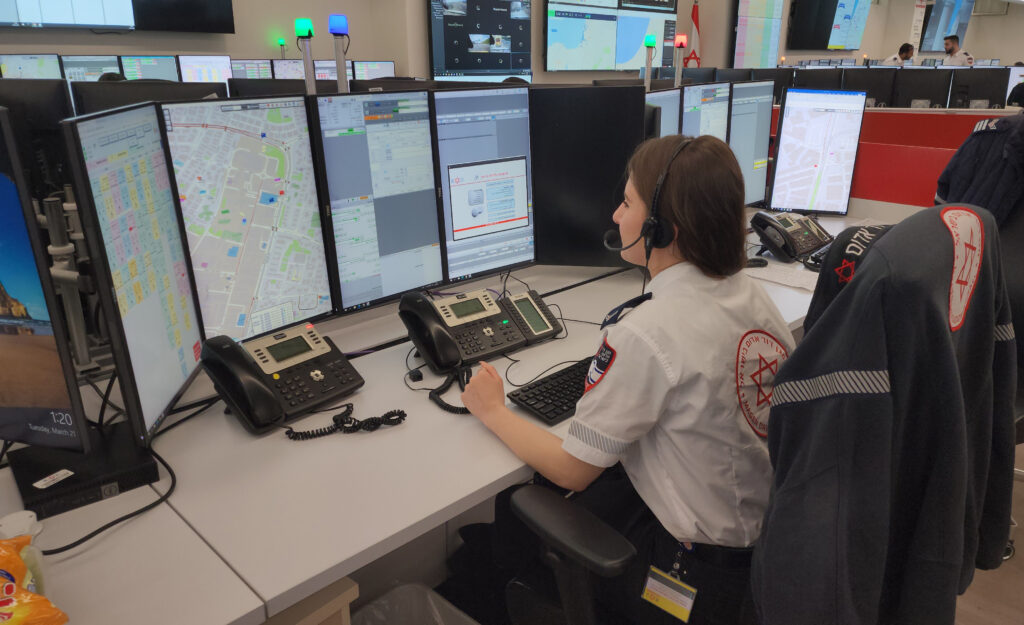
Wide eyed, I watched the ambulances roll out. The computer screens spilt into live feeds from the event, news reals, and statistics. The maps kept on updating with exact locations of ambulances and paramedics, analyzing and re-analyzing the precise needs, as data kept flowing in.
“MDA works by a strict code of procedures and ethics. We must be able to reach every place and treat everyone, in every possible situation that arises, be it health emergencies, terror attacks, missile attacks, or natural disasters,” MDA Director-General Eli Bin explains.
Ido Rosenblat, chief information officer (CIO), picks up the conversation. “In Israel there is no such thing as a typical day. I arrived at 2:30 a.m. because of an emergency plane landing at Ben Gurion Airport that required massive resources. A couple of hours later there was a tragic private plane crash, and then two soldiers were stabbed by a terrorist, and of course all the usual day-to-day things like accidents, illnesses, hospital transfers, and such. We are always on alert, always ready.”
Playing a life and death game of chess
In 2006, during the Second Lebanon War, Israel found itself dealing with multiple, simultaneous attack arenas in proximity. The American-developed system struggled, and the operators found themselves reverting to pen and paper to try and make sense of the events in real time and comprehend the best way to divide the resources between the sites.
“We were playing a game of chess and found ourselves lagging behind. It was a matter of life and death, in the most literal way possible, and something needed to change,” recalls Rosenblat.
An impossible equation that has to be solved
“Our needs arise from the field, and we don’t have the luxury to adapt slowly. We are constantly running forward, changing, adapting, and growing,” says Bin.
MDA realized it needed its own computer-aided system to meet its unique needs and set forth, building a technological platform based on machine learning. Today, Rosenblat, himself a Medevac paramedic, leads a team of 50 full-time programmers and coders, who use artificial intelligence to continually upgrade its capabilities.
“We are constantly working in multiple arenas and sites, diverting resources from one place to the other. We don’t have the time it needs for humans to do the math,” Rosenblat elaborates. “It’s an impossible equation, that involves 10 different regions covering the entire country, 1,300 ambulances, 600 Medicycles, 3,200 employees, 30,000 volunteers, 6,000 defibrillators, hospital availability, roadworks, and the constant need to make sure that no section is abandoned.
“We solved this equation by building a platform that connects the entire country together to one machine learning-based network that decides how the situation is going to be played, taking into account real life changes as soon as they occur. We are on the scene within minutes of the event. Of any event.”
Read the full article on Haaretz’s Nation of Innovation>>

