





Americans wanted to get ambulances to Israel during a war. That meant doing something they’ve always done in a way they’ve never done it.

Yoav Halper’s phone rang on the worst Saturday morning of his life with a call that he was expecting.
It was a few hours after Hamas attacked Israel on Oct. 7 when Halper first heard from his contacts at Magen David Adom, the country’s national ambulance and paramedic organization. They needed as many ambulances as they could get as fast as they could get them—and they knew just the person to call.
Halper would play a vital role in the response to the deadliest day for Jews since the Holocaust. He runs a company that imports emergency vehicles to Israel, which usually means shipping ambulances from the U.S. by ocean freighter. But he couldn’t wait months for them to arrive in this case. There was only one way to help in time.
He would have to figure out how to make ambulances fly.
“After I got the phone call,” he said, “I quickly understood that we are facing a very big logistics event.”
This very big logistics event that began on a Saturday morning ended the next Friday afternoon when a cargo plane touched down near Tel Aviv.
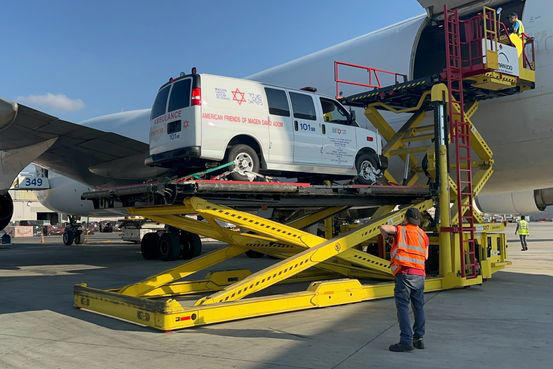
Inside the belly of that Boeing 747 were vans donated by Americans, transformed into ambulances in Indiana, driven to New York on flatbeds and flown to Israel. They were lowered to the tarmac, outfitted with medical supplies and dispatched around a country at war.
It’s a journey that normally lasts several months. This one was over in less than a week.
The mission to airlift 17 ambulances on four different cargo flights depended on a small team of people working across the world and around the clock. To accomplish it took a lot of choreography and more than a little chutzpah. If other logistical operations are puzzles, this one was more like a Rubik’s Cube. They knew what had to happen. What they didn’t know was how to make it happen in the least amount of time.
The companies and nonprofits responsible for what they call “the air train” had decades of experience moving rescue vehicles from the U.S. to Israel. But this was the greatest challenge of their careers.
Success meant doing something they’ve always done in a way they’ve never done it.
“Never even anything close to it,” said Tom Moleski, a founder of Medix Specialty Vehicles, which converted American vans into Israeli ambulances.
The person at the center of the action was Yoav Halper, 40, who coordinated the effort from Tel Aviv, taking cover with his toddler twins several times a day at the sound of rocket sirens. Like other Israelis, he was devastated. He wanted to do anything he could to help his country.
Halper owns a business called Elite Ambulances with his father and works closely with the country’s importer of General Motors vehicles. He’s also connected to American Friends of Magen David Adom, the U.S. fundraising arm of Israel’s emergency service. Nobody was more qualified for the job of getting ambulances from one country to the other.
AFMDA typically sends about 75 a year, but this is not a typical year, and the organization’s donors have sponsored 148 in the two weeks since the conflict began.
Those funds have provided most of the 1,400 ambulances in the Magen David Adom fleet, including basic life-support vehicles ($115,000) and mobile intensive-care units ($140,000). They’re not the box ambulances that drive around the U.S. They’re actually Chevrolet vans. The chassis is sent from GM’s factory in Wentzville, Mo., to the Medix facility in Elkhart, Ind., where the empty vehicle becomes a proper Israeli ambulance. It’s stuffed with cabinets for equipment and medicine, an oxygen system, a communications center, heating, air conditioning, emergency lighting and sirens—and finished with a red Star of David.
The ambulance manufacturer was founded by Moleski, who has known the Halpers for 20 years, so he wasn’t surprised when he woke up that Saturday to an urgent text at 3:14 a.m. from Yoav: Call me please.
Anybody who does any business with Israelis is used to messages like that one.
“It’s early here,” Moleski wrote back. “I can’t call.”
“There is war in Israel,” Halper wrote.
“There’s always a war in Israel,” Moleski wrote.
Halper explained why this time was horrifically different.
“Are you in a safe place?” Moleski wrote. “I’m available.”
He climbed out of bed, called him and became part of the emergency response to help the emergency responders. His next call was to Amy Hoover. She is officially the administrative coordinator at Medix and unofficially the person at the company who knows how to get stuff done. “I do a little bit of everything,” she said. Hoover jumped off the phone to analyze inventory and put together a list of the ambulances that were ready to roll. It turned out they had 17 waiting to be shipped, and now they were going to arrive months ahead of schedule.
There was a Zoom call with logistics specialists from every step of the supply chain on Saturday afternoon, and Hoover found the truckers who would transport the ambulances to New York by Saturday night.
“I drove into my parking lot at 7 a.m. on Monday and they were lined up and ready to go,” she said.
They often make pit stops for dedication events honoring the donors whose names are on the doors—traveling by flatbeds to avoid unnecessary mileage—before the ambulances make the long trek to Israel from the Port of Baltimore. “Economically, it’s the best way to get them there,” said Bonnie Finley, AFMDA’s development, projects and operations manager. “Unfortunately, it’s not the quickest.”
A spokesman for Magen David Adom said this mission will cost about $1 million, a figure that includes the first 17 vehicles and another load of 14, which means flying ambulances was roughly 10 times the price of shipping them.
But they didn’t have a choice. The journey across the ocean can take six weeks. That was six weeks too many. The donors waived their ceremonies and the ambulances were driven straight from the Medix parking lot to a hangar at John F. Kennedy International Airport.
Read more on the Wall Street Journal>>

