





Lotan, who lives in Israel, visited Los Angeles recently to address the local Jewish community about the ongoing effort of MDA to provide lifesaving services to Israelis.

Felix Lotan is no stranger to responding to emergency medical situations.
A veteran paramedic in Israel’s national emergency response service, Magen David Adom (MDA), he’s helped not only in the event of terror attacks but also in response to natural disasters, including earthquakes, floods and wildfires, and during daily medical emergencies, including heart attacks, car accidents, strokes and baby deliveries.
Still, the events of Oct. 7 — when Hamas terrorists conducted an unprecedented massacre of approximately 1,200 Israeli civilians and abducted about 240 others — was unlike any situation he had experienced. Over the course of a typical day, MDA’s emergency response dispatchers ordinarily receive about 4,000 calls, but on that tragic Shabbat in October, MDA fielded approximately 4,000 calls per hour, while deploying more than 1,300 ambulances, Lotan, senior paramedic and the head of disaster preparedness at Magen David Adom, told the Journal.
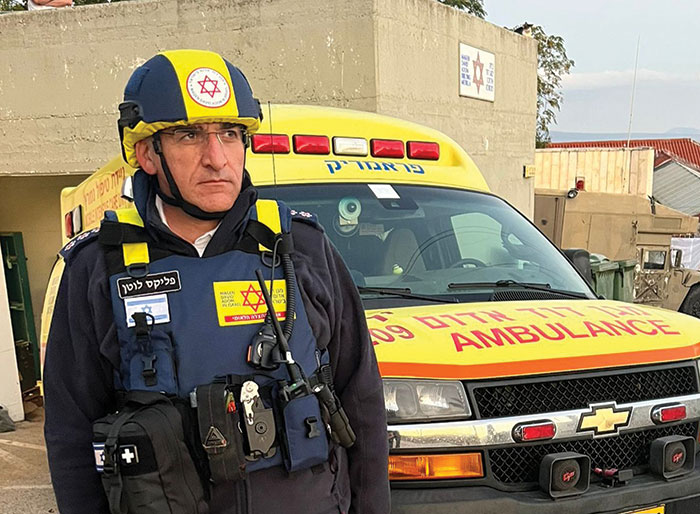
“One of the things our EMTs and paramedics are trained to do, when something happens, people are running away from the event. Our teams were running into the event.” -Felix Lotan
“I can tell you about many, many hard calls we received,” Lotan said during a recent interview at the Los Angeles office of American Friends of Magen David Adom (AFMDA). “One of the things our EMTs and paramedics are trained to do, when something happens, people are running away from the event. Our teams were running into the event.”
Lotan has worked at MDA for nearly 20 years. His role has taken him all over the world, including Turkey, where he supported a rescue effort after the country was struck by a 7.7 earthquake earlier this year, and Houston after Hurricane Harvey in 2017.
Lotan, who lives in Israel, visited Los Angeles recently to address the local Jewish community about the ongoing effort of MDA to provide lifesaving services to Israelis. MDA is Israel’s national emergency medical services organization and its official representative to the International Red Cross.
Since Oct. 7, the International Red Cross has been criticized by supporters of Israel for not being a neutral party in the current Israel-Hamas war and for appearing more concerned about the dangers facing Palestinians in Gaza than about Israeli hostages being held by Hamas.
Asked about this criticism, Lotan said it was vital the Red Cross be granted access to the Israeli hostages currently in captivity.
“We expect the Red Cross to visit the people who are being held in Gaza, to see what their needs are, and to deliver messages to their families [about] whether they’re dead or alive,” Lotan told the Journal. “This is one of the Red Cross’ missions, and Magen David Adom expects the Red Cross to fulfill this mission.”
Beyond those remarks, Lotan’s conversation with the Journal focused primarily on the daily responsibilities of MDA as well as the support it receives abroad from people living in the U.S. While MDA’s role is mandated by the Israeli government, it’s not a government agency and does not receive government funding for its general operations—thus there’s the need for AFMDA, which raises funds and awareness throughout the United States for MDA.
MDA is comprised of volunteers and staff. It is Israel’s leading ambulance service—its ubiquitous life support ambulance is “the workhorse of the MDA fleet,” according to the AFMDA website — and it is the operator of Israel’s national blood bank, the Marcus National Blood Services Center, as well as the Sussman Family Foundation Human Milk Bank, which maintains a ready supply of breast milk from healthy mothers.
Recent events, Lotan said, have underscored the need for maintaining the breast milk supply.

