





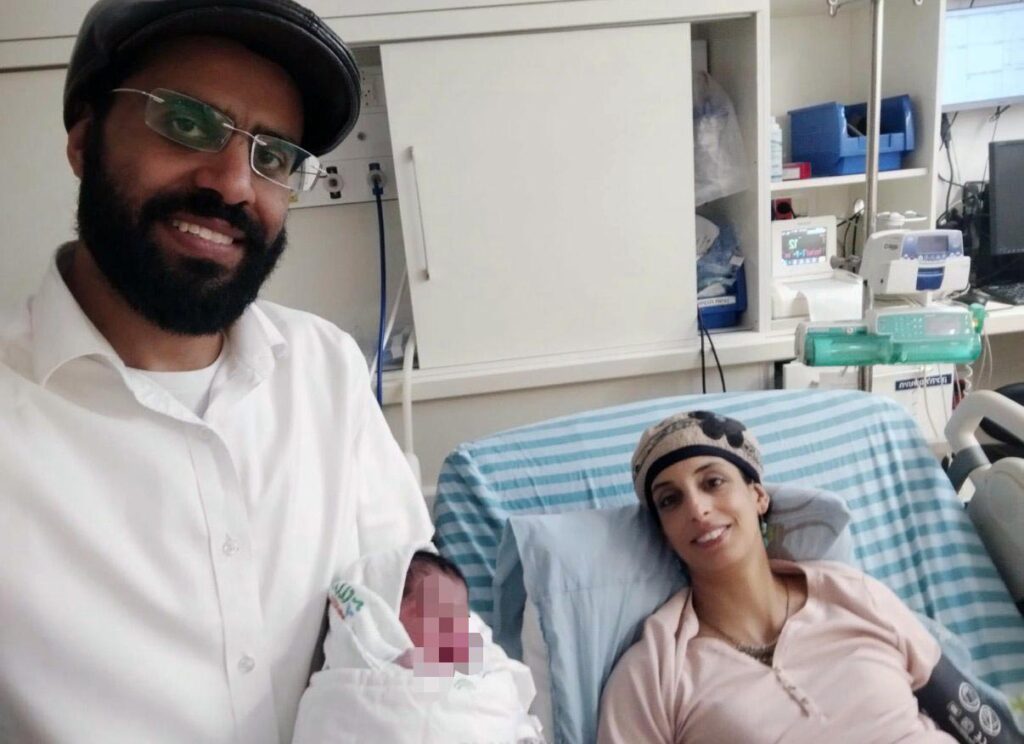
As a volunteer Magen David Adom senior EMT and ambulance driver, rabbi, and father, Uriel David Shlomi has spent years answering calls that arrive without warning and demand everything at once. But two days before the holiday of Shavuot began, one of the most important calls of his life came not from the MDA dispatch, but from his own home.
The evening had started quietly. Around 6:45 p.m., Atara, his wife, felt mild contractions, nothing that seemed pressing. Shlomi left for synagogue to lead the evening prayers and the rest of his family stayed at home. Then, just after 8:00 p.m., everything shifted. Atara’s labor accelerated with sudden, overwhelming speed. She moved to the bathroom and understood almost immediately that there would be no time to reach a hospital. Their eldest daughter called her father to come home immediately.
Shlomi was deep in silent prayer when his phone rang. “As I was opening my heart in prayer,” he said, “the delivery began.” He grabbed his MDA ambulance bag and ran.
Atara, calm and experienced, was no stranger to emergency medicine after years of marriage to Shlomi. Before he arrived, Atara delivered the baby herself, the umbilical cord briefly wrapped around the newborn’s neck. She removed it, and seconds later, their daughter cried.
When Shlomi got home a few minutes later, he knew exactly what he had to do. He assessed mother and baby, wrapped the infant in a blanket, and clamped and cut the umbilical cord, before coordinating with MDA’s National Emergency Dispatch Center. Once his wife and daughter were stable, he did what he had done for strangers countless times before, he got behind the wheel of an ambulance. This time, his wife and newborn daughter were in the back. He drove them to Emek Medical Center in Afula.
The birth came just days before Shavuot, the Jewish holiday marking the Jewish people receiving the Torah at Mount Sinai and the transmission of values across generations, timing that Shlomi found difficult to ignore. “Shavuot reminds us that we were given more than traditions,” he said. “We were given direction.”
Shlomi has spent years living out that idea across his multiple roles. Beyond his volunteer work with MDA, he leads a congregation, has served in IDF reserve duty, and in recent months has helped hundreds of new immigrants integrate into his community, connecting arriving families with housing, belonging, and support networks during a period of heightened uncertainty for Jewish communities abroad. He frames all of it through the same lens: Kol Yisrael arevim zeh la’zeh, the Talmudic principle that every person bears responsibility for one another.
“We don’t live only for ourselves,” Shlomi said. “Our mission is to encourage living life.” His newest daughter arrived days before a holiday about transmission and continuity, the newest link in the chain.

